
What Do 100 Speed Levels Actually Change on a Handheld Fan?
A 100 speed fan is not 100 times more powerful than a regular fan. Its main advantage is finer control between low and high airflow.
Instead of choosing only low, medium, and high, a 100 speed handheld fan gives you more room to adjust the airflow until it feels right.
That can be useful when the fan is close to your face, when you move between indoor and outdoor environments, or when you do not need maximum output all the time.
The number of speed levels matters, but only as part of the overall fan design. Maximum airflow, battery runtime, weight, controls, and how you actually use the fan still matter just as much.
What Does “100-Speed” Actually Mean?
When a fan is advertised as having 100 speed levels, it generally means the usable adjustment range has been divided into many smaller steps.
It does not mean the fan has 100 motors, nor does level 100 automatically make it stronger than every fan with three or five speeds.
Electronic motor controls can vary fan speed over a range rather than limiting operation to only a few fixed outputs. One common method used in fan systems is pulse-width modulation, or PWM. Nidec explains that PWM fan speed can be changed by adjusting the duty cycle of the control signal in its fan speed control documentation.
This is a general example of how electronic fan speed can be controlled. It does not mean every 100-speed portable fan uses the same control method.
For the user, the practical difference is simpler:
A 3- or 5-speed fan gives you a few distinct choices.
A 100-speed system gives you many more points between minimum and maximum output.
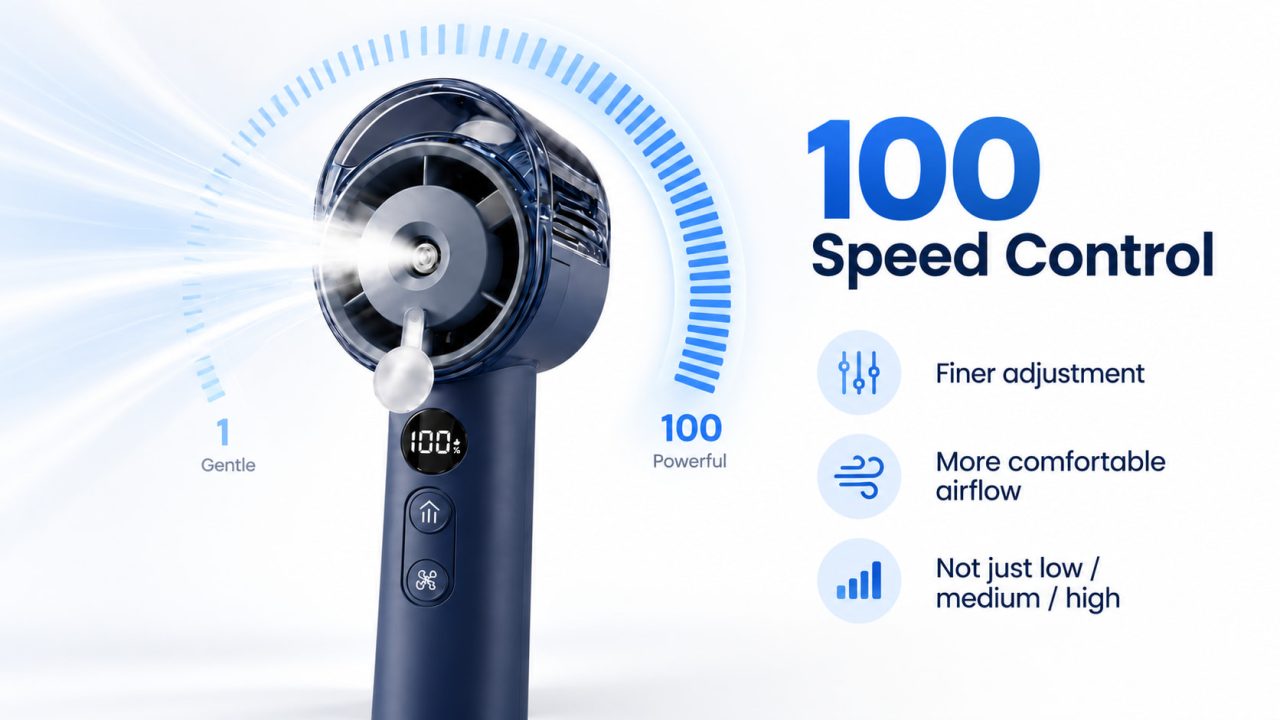
That can make it easier to find a comfortable airflow level without jumping from “too weak” to “too strong.”
Is 100-Speed Control Better Than 3 or 5 Speeds?
A fan with three or five well-chosen fan speed settings may be completely adequate if you usually switch between a gentle breeze and maximum airflow.
More settings become useful when small changes actually affect comfort.
For example, airflow that feels comfortable while walking outdoors may feel too strong when the fan is held close to your face indoors. With finer adjustment, you can reduce the airflow gradually instead of jumping directly to a much lower fixed mode.
The important distinction is:
More speed levels give you finer control. They do not automatically give you stronger maximum airflow.
A 100-speed model can still have a lower maximum wind speed than another fan with fewer settings.
When Do Fine Speed Adjustments Actually Help?
Fine control is most useful when your airflow needs change during the day.
Close-Range or Indoor Use
A handheld fan may sit only a short distance from your face or body.
At that distance, maximum airflow can be unnecessary. Smaller adjustments make it easier to find a level that feels comfortable without creating more airflow than you want.
The same applies when using a portable fan on a desk.
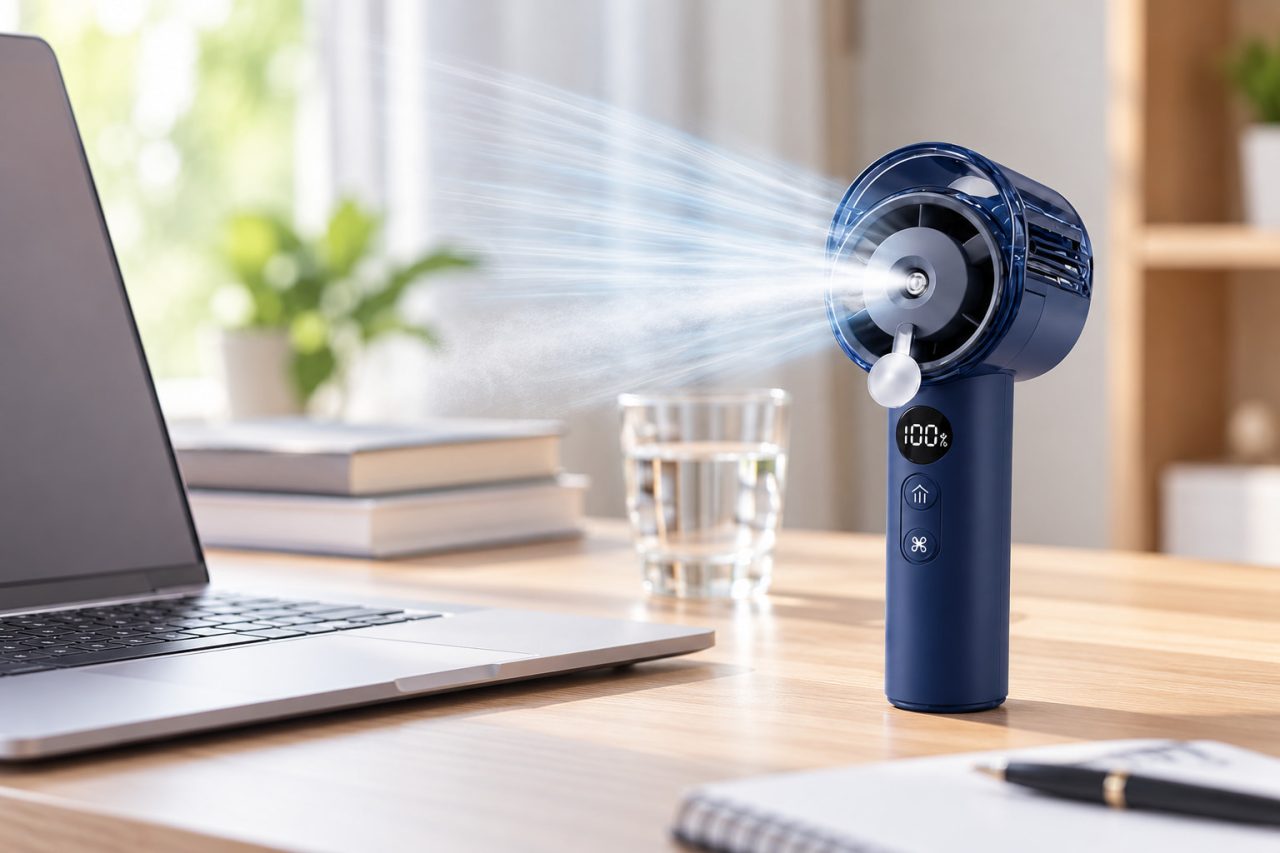
Moving Between Different Environments
You may prefer stronger airflow while walking outside, then reduce it after entering a cooler indoor space.
A wider adjustment range lets you make that change gradually instead of switching between only a few preset levels.
When Battery Runtime Matters
Lower motor output will generally require less power than running a fan at maximum output, although actual battery use depends on the motor, battery, electronics, and other active functions.
Fine adjustment can help you avoid running the fan harder than necessary.
However, a speed number by itself does not tell you the exact battery runtime. Use manufacturer runtime data when available rather than assuming that a certain level will save a specific percentage of battery.
Does 100-Speed Control Mean Stronger Airflow?
Speed levels describe how finely the output can be adjusted.
Maximum airflow describes how much air the fan can deliver under its highest setting and test conditions.
These are different things.
Actual airflow can be influenced by:
- motor output;
- blade or impeller design;
- air outlet and duct shape;
- fan size;
- measurement distance;
- testing method.
That is why the number of settings should not be used as a shortcut for judging fan performance.
If you want to understand portable fan wind speed, WindBillion’s Portable Fan Wind Speed guide explains what m/s means and why measurement conditions matter.
A fan with fewer settings may still produce stronger maximum airflow, while a 100-speed model may simply offer more precise control across its operating range.
Is Stepless Fan Speed the Same as 100 Speeds?
The terms describe related ideas, but they are not always used in exactly the same way.
“100 speeds” usually tells you that the manufacturer provides a large number of selectable adjustment levels.
Stepless fan speed describes the idea of changing output gradually rather than being limited to a few traditional fixed modes.
Some manufacturers use both terms together, such as “100-level stepless adjustment,” to describe a wide range of fine incremental control.
For the user, the wording matters less than the experience.
The control should be easy to adjust, respond predictably, and let you reach the airflow level you actually want.
Who Benefits Most From a 100 Speed Handheld Fan?
A 100 speed handheld fan can be especially useful if you:
- use the fan close to your face;
- move frequently between indoor and outdoor environments;
- prefer precise airflow control;
- use one fan in both handheld and desktop positions;
- frequently adjust airflow instead of leaving the fan at one setting.
Someone who almost always runs a fan at full power may notice less benefit from having 100 adjustment levels.
For that user, maximum airflow, battery runtime, size, and weight may be more important.
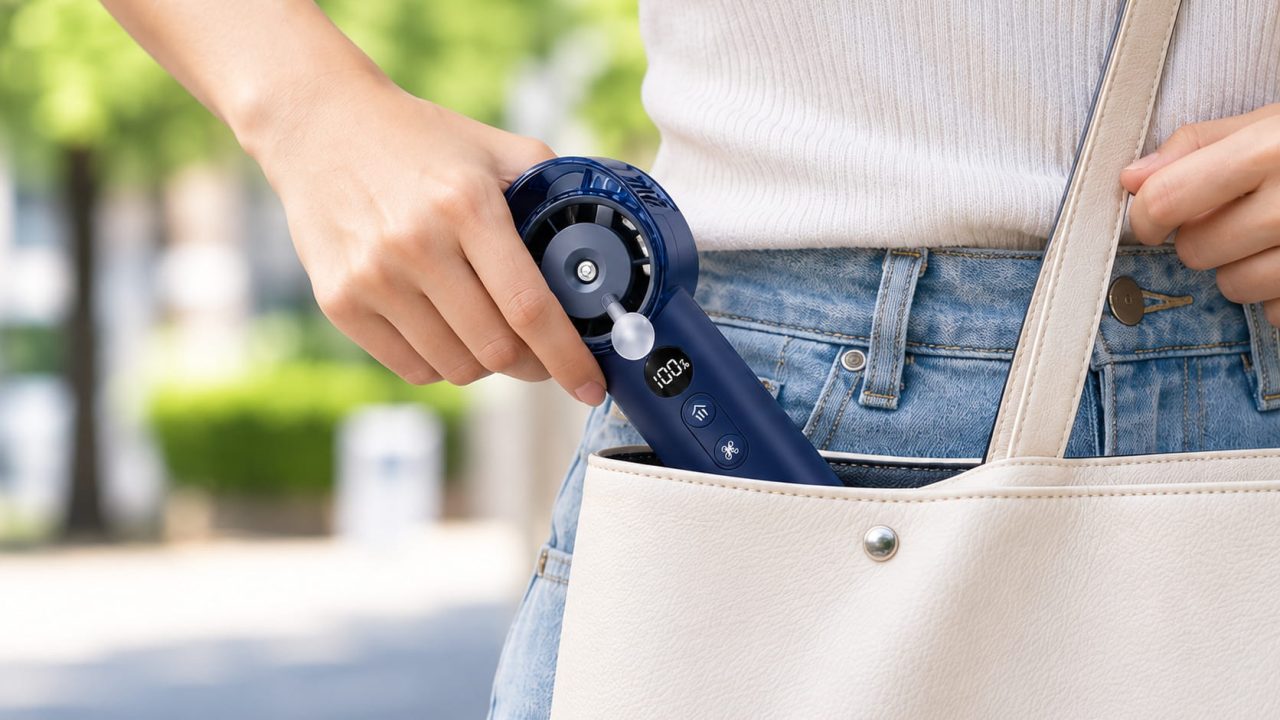
WindBillion’s FS36 handheld cooling mist fan is one example of a portable model with 100-level stepless airflow adjustment. Its published specifications also include airflow up to 6.0 m/s, showing why speed-setting count and maximum airflow should be considered separately.
What Else Should You Compare When Choosing a Portable Fan?
A useful portable fan comparison should look at more than the number of speed settings.
When deciding how to choose a portable fan, start with the way you expect to use it.
If you mainly want strong airflow outdoors, maximum wind speed and battery runtime may matter more than having 100 settings.
If you use the fan close to your face, at a desk, or across several environments during the day, finer speed adjustment may be more useful.
Other factors worth comparing include:
- maximum airflow;
- battery capacity and runtime;
- product weight;
- charging method;
- ease of adjusting the controls;
- handheld, desktop, or wearable use;
- additional cooling functions such as mist or a cooling plate.
The controls also matter. A large number of settings is less useful if changing them feels slow or inconvenient.
WindBillion’s FS36 and FB23 comparison guide compares airflow, battery information, cooling functions, and different usage styles.
The best portable fan is not necessarily the one with the most speed levels. It is the one that gives you enough airflow, enough control, and enough runtime for the way you actually use it.
Fine Control Matters More Than the Number Itself
A 100 speed fan can be useful because it gives you finer control over airflow, not because the number 100 automatically means better cooling or stronger performance.
For people who frequently adjust airflow throughout the day, that extra control can make a handheld fan more flexible and comfortable to use.
For others, three or five well-designed settings may be enough.
When comparing portable fans, look beyond the number on the specification sheet. Consider airflow range, maximum performance, battery runtime, weight, controls, and how the fan fits into your everyday routine.