
When comparing portable fans, you may see portable fan wind speed listed as 3 m/s, 5 m/s, 7 m/s, or higher. But what does that number actually tell you about the airflow you will feel?
m/s means meters per second. On a portable fan, it describes how fast the air is moving at the point where the measurement is taken. A higher m/s value generally means faster-moving air under the same test conditions.
However, the largest number does not automatically mean the fan will feel cooler, reach farther, or work better for you.
Measurement distance, airflow direction, outlet design, and the way a fan is actually used can all change what you feel.
That is why portable fan wind speed is best treated as a performance reference rather than a score where the highest number automatically wins.
What Does m/s Actually Measure on a Portable Fan?
If you are wondering what m/s means on a fan, the short answer is that it measures air velocity in meters per second.
If the air from a fan is measured at 5 m/s, the air is moving at approximately five meters per second at the measurement point.
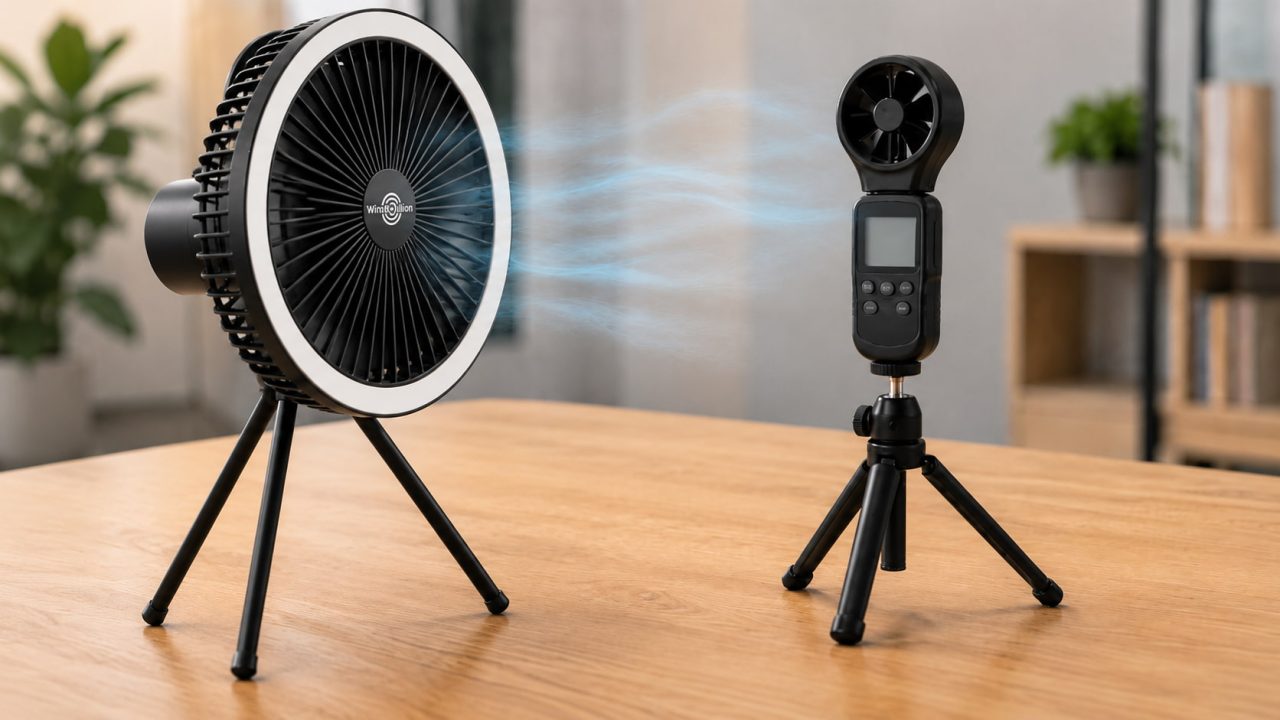
That final detail matters.
A wind-speed figure tells you about air velocity at a specific location. It does not directly tell you:
- how wide the airflow spreads;
- how far it remains noticeable;
- how quiet the fan is;
- how long it can maintain that speed;
- or how comfortable it will feel at your normal use distance.
Formal testing methods also exist for household fan performance. For example, IEC 60879 covers performance measurement methods for household and similar comfort fans.
In practical terms, a wind-speed number becomes more useful when you also know how and where it was measured.
m/s Is Not the Same as RPM
You may also see RPM, or revolutions per minute, in fan specifications.
RPM tells you how quickly the fan’s rotating system is turning. m/s describes how quickly the resulting air is moving at a measurement point.
The two are related, but they are not interchangeable.
Blade shape, outlet size, internal air channels, and housing design can all affect how rotation is converted into airflow. Two fans with similar RPM figures can therefore produce different air velocities.
A high RPM number alone should not be treated as proof of stronger usable airflow.
Why Can the Same m/s Feel Different Between Fans?
Two portable fans can both publish a wind speed of 5 m/s and still feel noticeably different.
One may produce a narrow, concentrated stream through a compact outlet. Another may spread airflow across a larger area.
The air velocity at one measurement point can be similar even though the overall experience is not.
Measurement Distance Matters
Measurement distance is one of the most important factors when reading fan wind speed.
A handheld fan may sit only a few inches from your face.
A portable waist fan usually directs airflow from close to the body, while a portable camping fan may sit several feet away on a table or tent floor.
Those distances change how useful a maximum wind-speed figure is.
If one manufacturer publishes 7 m/s and another lists 5 m/s, the first product should not automatically be assumed to feel stronger at your normal position unless the measurement conditions are reasonably comparable.
Airflow Pattern Matters Too
A focused stream can feel powerful over a small area.
Broader airflow may feel less intense at one point while reaching more of your nearby space.
Neither approach is inherently better.
Wearable fans often benefit from targeted airflow because they stay close to the body. A tabletop or camping fan may place more emphasis on direction and coverage.
So when you read a wind-speed figure, consider not only how fast the air moves, but also where that airflow is intended to go.
Can You Compare m/s Between Different Portable Fans?
Yes, but only with caution.
When you compare fan wind speed between different models, the figures are most useful when measurement distance and test conditions are similar.
If those details are not available, treat published m/s figures as product-specific references rather than strict rankings.
For example, suppose:
Fan A: 7 m/s
Fan B: 5 m/s
does not prove that Fan A will feel 40% stronger in everyday use.
The products may use different outlet designs, fan sizes, airflow patterns, or test distances.
This matters even more when you are comparing different types of portable fans rather than two products designed for the same purpose.
Does Higher m/s Always Mean Better Cooling?
No. If you are wondering whether higher m/s is better for a fan, the answer depends on how and where the fan will be used.
A higher m/s value generally means faster-moving air at the measurement point, but stronger airflow is not always the most useful airflow.
For outdoor work in hot weather, stronger and more direct air movement can be valuable.
At a desk, gentler airflow may remain comfortable for longer periods.
Beside a bed, low-speed comfort and noise can matter more than maximum output.
There is therefore no single m/s value that can be called the best portable fan wind speed for every situation.

Faster Air Does Not Mean Colder Air
A conventional portable fan moves surrounding air. It does not refrigerate that air like an air conditioner.
Faster airflow can increase the cooling sensation on your skin, but a higher m/s figure does not mean the fan is producing colder air.
Multifunction products make this distinction even more important.
A portable misting fan adds fine mist to the airflow, while a cooling-plate fan can provide direct-contact cooling. Those functions affect the cooling experience in ways that are not represented by the m/s number alone.
Maximum Speed Is Not Always the Setting You Need
Most rechargeable portable fans offer several airflow levels.
Maximum output may be useful during a hot outdoor activity, but it may be unnecessary while working at a desk, commuting, reading, or relaxing indoors.
A useful fan therefore needs more than an impressive top number. It needs airflow settings that match different situations.
What WindBillion Products Show About Wind Speed
WindBillion’s current product range provides a useful example of why m/s needs context.
| Model | Published Wind Speed | Intended Use Style |
|---|---|---|
| H12 Camping Fan | 2.0–5.2 m/s | Camping/tabletop |
| FB23 Cooling Mist Fan | 3.5–7.5 m/s | Neck-wearable / handheld / desktop |
| WF04 Ice Plate Waist Fan | 3.8–7.9 m/s | Waist-worn / close-range |
Looking only at the maximum figures gives:
WF04: 7.9 m/s
FB23: 7.5 m/s
H12: 5.2 m/s
But that is not a best-to-worst ranking.
The H12 is a portable camping fan with a larger fan structure and is normally positioned farther from the user. FB23 combines portable airflow with mist and a cooling plate, while WF04 is a portable waist fan designed for more targeted close-range airflow.
These products differ in structure, use distance, and cooling method.
The useful lesson is not which number is largest. It is that the meaning of an m/s figure changes with the type of fan and how it is used.
How Does Wind Speed Affect Battery Runtime?
Higher fan speeds generally require more power from the motor, which can reduce cordless runtime.
That creates a straightforward trade-off:
Stronger airflow → more immediate air movement
while often:
Higher speed → shorter battery runtime
Maximum wind speed and maximum runtime therefore usually describe different operating conditions.
For a long workday, moderate airflow may be more practical. During a shorter period outdoors, stronger airflow may matter more.
This relationship is also why battery capacity should not be considered by itself. Our portable fan battery life guide explains how battery size, fan speed, and active features work together.
How Should You Read Portable Fan Wind Speed?
You do not need to understand fan engineering to read portable fan wind speed correctly. The key is to put the m/s figure into context.
Look at the Range, Not Just the Maximum
Knowing how to read fan wind speed means looking beyond the highest number.
A published range such as 3.8–7.9 m/s gives more context than simply Maximum 7.9 m/s.
It shows that the product can operate across different airflow levels rather than only at one peak setting.
Check the Measurement Conditions
When measurement distance or testing information is available, use it.
If those details are missing, be careful about treating small differences in maximum m/s as meaningful.
For example, 7.5 m/s versus 7.9 m/s should not automatically decide between two products if the test conditions are unknown.
Consider Your Normal Use Distance
Think about where the fan will actually sit:
hand → face
waist → upper body
desk → seated user
tent floor → sleeping area

A wind-speed number measured near the outlet cannot fully describe what you will feel at every one of those distances.
Read Wind Speed Together With the Use Case
Wind speed is only one part of the decision.
At a desk or beside a bed, noise, low-speed comfort, and airflow direction may deserve more attention than maximum output.
Outdoor use puts greater emphasis on strong airflow, hands-free positioning, and runtime.
Camping introduces another set of priorities, including coverage, placement, battery life, and portability.
The right balance depends on where and how you plan to use the fan.
If you are comparing several fan styles, you can also compare WindBillion portable fans by intended use, battery performance, and cooling method.
Use m/s as a Reference, Not a Score
The m/s specification gives you a measurable indication of air velocity, but it should not be treated as a simple performance score.
A higher figure generally means faster-moving air under the stated measurement conditions. It does not automatically mean the fan will feel cooler, reach farther, or work better in every situation.
When comparing portable fans, consider the wind-speed figure together with measurement conditions, use distance, airflow pattern, runtime, and intended use.
If one fan is rated at 5 m/s and another at 7 m/s, the more useful question is not simply which number is higher.
It is:
Will this airflow work well at the distance and in the situation where I actually plan to use the fan?
That is the better way to understand portable fan wind speed.