
A fan with cooling plate can provide localized cooling when its plate is cooler than your skin, but it does not cool a room like an air conditioner.
The fan moves air across a wider area, while the cooling plate provides more concentrated cooling where it touches the body. That means the plate is useful for direct personal cooling, not for lowering the temperature of an entire room.
For someone considering a fan with cooling plate, the important question is not simply whether the plate feels cold. It is what that cooling actually does and whether the feature fits the way you plan to use the fan.
How Does a Cooling Plate Fan Work?
A normal portable fan mainly relies on airflow.
Moving air across the skin can improve comfort by helping sweat evaporate and by carrying warm air away from the body. The air itself is usually still close to the surrounding temperature.
A cooling plate works differently.
Some electronic cooling plates use thermoelectric technology. When electrical current passes through a thermoelectric module, heat is transferred from one side to the other, creating a cooler side and a warmer side. This process is known as the Peltier effect. The European Thermoelectric Society’s explanation of thermoelectric cooling describes this process in more detail.
However, not every product described as having an ice plate uses the same cooling mechanism. Check the manufacturer’s specifications before assuming how a particular model produces its cooling effect.
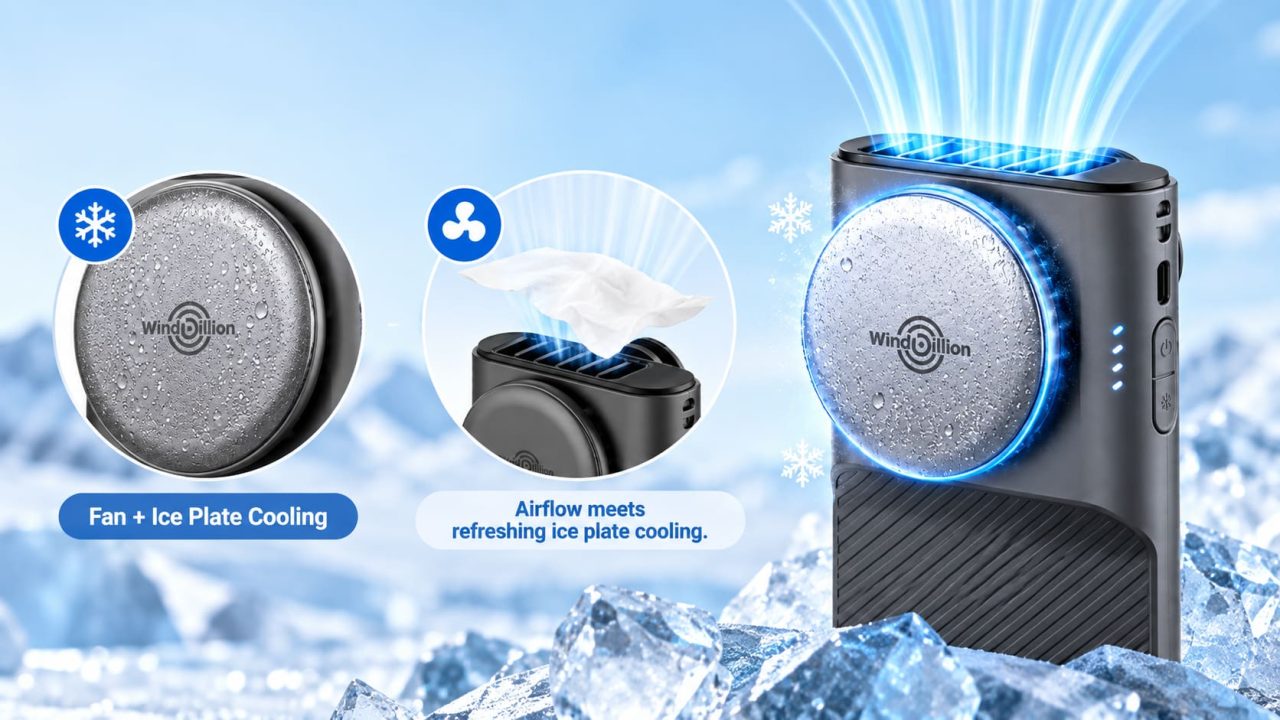
The important point is simple: the plate itself becomes cooler, allowing it to provide a stronger cooling sensation when it touches the skin.
What Does the Plate Actually Cool?
The cooling plate mainly cools the area in direct contact with it.
When the plate is cooler than your skin, heat can transfer from the skin to the plate. This creates a localized cooling sensation around the contact area rather than cooling your entire body or room.
The effect depends on the plate’s temperature and how it is used. A cooling plate fan should therefore be understood as a personal cooling device, not a replacement for room air conditioning.

Why Does It Feel Colder Than Fan Air?
Air from a portable fan is usually close to the surrounding air temperature. Increasing fan speed moves more air, but it does not necessarily make the air colder.
A cooling plate can feel colder because its surface may be below skin temperature. When the two touch, heat transfers from the warmer skin toward the cooler surface, creating a more immediate cooling sensation.
Longer contact does not automatically mean better results. Follow the product instructions and avoid keeping a very cold plate against one area longer than recommended.
How Is It Different From Normal Airflow?
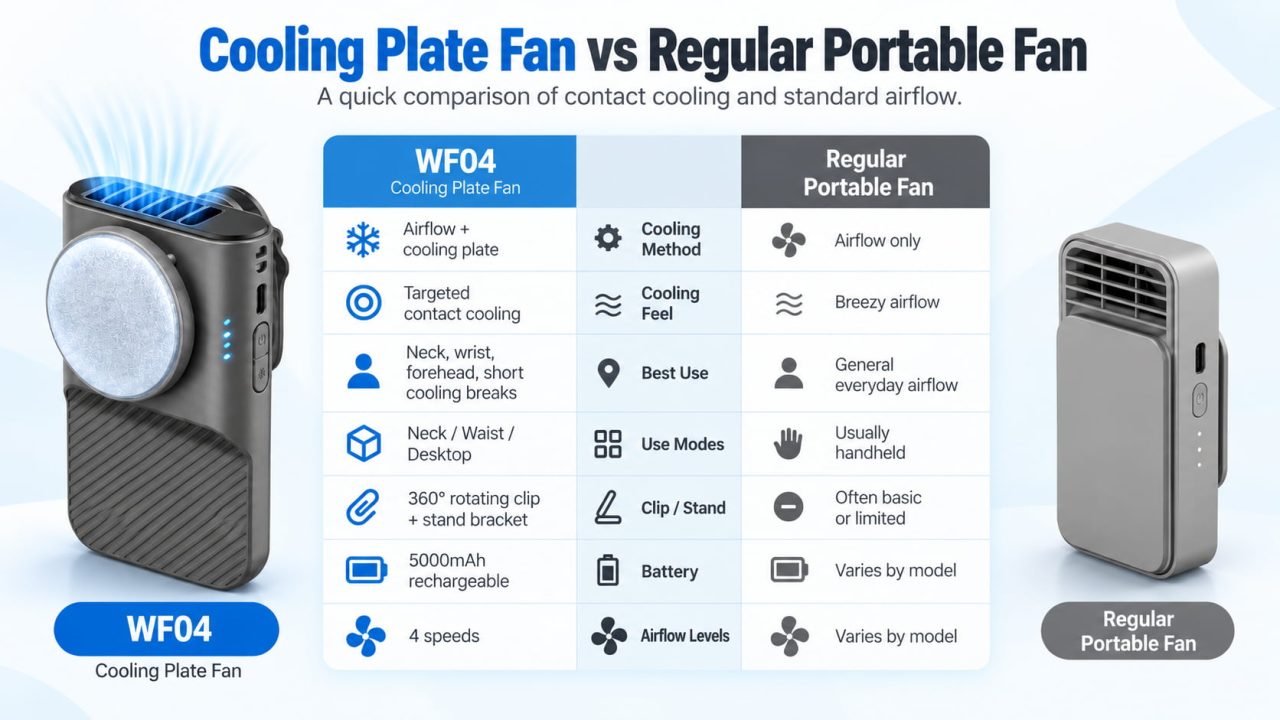
Cooling plates and normal fan airflow provide different types of personal cooling. Airflow moves across a wider area, while a cooling plate provides direct-contact cooling at a specific spot.
The better option depends on how you use the fan. Steady airflow may be more practical for extended use, while a cooling plate adds a more concentrated cooling sensation when you want it.
The following comparison explains what each method can and cannot do.
Does a Cooling Plate Make the Fan Air Colder?
A handheld fan with cooling plate may include both airflow and contact-cooling functions, but the plate does not automatically refrigerate all the air leaving the fan.
The fan motor moves surrounding air.
The cooling plate cools its own surface.
These two functions can work together, but they should not be confused with air-conditioning.
A better way to evaluate the product is to ask whether the airflow is strong enough for normal use and whether the plate can be positioned comfortably when extra cooling is wanted.
Is a Cooling Plate Better Than Normal Airflow?
Neither one is automatically better.
Normal airflow is usually more practical when you want continuous cooling over a broader area.
For example, someone walking outdoors, working, commuting, or sitting for a long period may benefit more from steady airflow.
A cooling plate is more useful when you want brief, concentrated cooling.
That can make it useful when normal airflow feels insufficient, and you want a more direct cooling sensation on one area of the body.
This is why some portable fans combine both functions instead of using one to replace the other.
For an example of how direct-contact cooling can work with a wearable fan, see WindBillion’s Ice Plate Waist Fan guide.
Does the Cooling Plate Use More Battery?
A rechargeable fan has a limited amount of stored energy.
The fan motor uses power, and a powered cooling plate also requires energy. When both functions operate at the same time, runtime can decrease.
That means the longest advertised runtime may not apply when the cooling plate is active.
Battery life can also change depending on:
- fan speed;
- cooling plate power;
- motor efficiency;
- misting or lighting functions;
- how many features are running at the same time.
When comparing products, look at runtime by operating mode instead of focusing only on battery capacity.
When Is a Cooling Plate Fan Worth Using?
A cooling plate is most useful when normal airflow is not enough, and you want a short burst of direct cooling on the skin.
It is not automatically necessary for every portable fan user. The value depends on how often you want concentrated cooling, how the device is worn or held, and whether the extra power use fits your routine.
For example, WindBillion’s WF04 waist fan with an ice plate combines airflow with direct-contact cooling in one wearable device.
When Is a Cooling Plate Most Useful?
A cooling plate is most useful when you want quick, targeted cooling in addition to normal airflow.
It can be useful when you want a quick cooling sensation after walking in hot weather, during a short outdoor break, or while waiting in a warm environment.
The fan design also matters.
A handheld model lets you place the cooling plate exactly where you want it, while a waist or neck fan may offer better hands-free use.
Before choosing a model, think about where the plate sits, how easy it is to use, and whether direct-contact cooling fits your routine.
Who May Not Need a Cooling Plate?
If your main goal is steady airflow for several hours, factors such as fan strength, weight, placement, and battery life may matter more.
A cooling plate can also increase power use and add complexity to the device.
Someone who rarely wants direct-contact cooling may be better served by a simpler portable fan with longer runtime.
On the other hand, a cooling plate can be useful for people who want a stronger cooling sensation in short bursts.
WindBillion’s Portable Fan Comparison can help compare different fan formats, cooling methods, and battery considerations.
A Cooling Plate Adds Targeted Cooling, Not Refrigerated Air
A cooling plate fan can provide real localized cooling when the plate becomes cooler than the skin.
What it does not do is turn a portable fan into a miniature air conditioner.
Normal airflow is better for broader, continuous cooling, while the cooling plate adds a more concentrated option when you want it.
The best fan with cooling plate is not simply the one with the lowest plate temperature. It is the one that balances airflow, contact cooling, battery life, and the way you actually plan to use it.