
Outdoor vendors may spend hours serving customers, handling products, taking payments, and restocking a stall with little opportunity to leave the area.
Portable fans for outdoor vendors can add useful personal airflow when natural ventilation is limited, but the right setup depends on how the vendor works. A waist fan may suit someone who moves frequently and needs both hands free, while a clip-on or desktop fan may work better behind a fixed checkout table.
Moving air can also improve comfort by helping sweat evaporate from the skin. It does not lower the outdoor air temperature, but in hot, still conditions it can make a market stall feel more manageable.
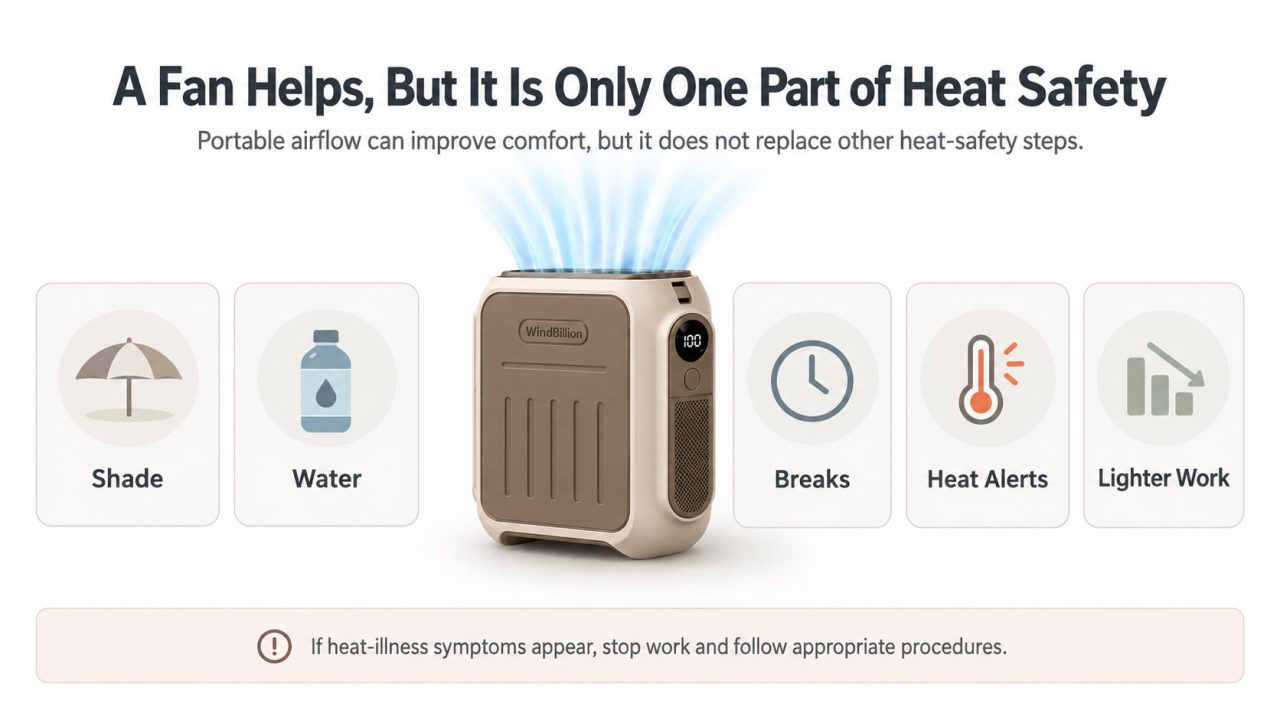
A fan should support shade, drinking water, and regular breaks rather than replace them.
What Makes Cooling an Outdoor Market Stall Difficult?
A canopy can reduce direct sun, but it does not automatically make the space cool.
Warm pavement, limited cross-breezes, nearby equipment, crowds, and long periods of standing can all increase discomfort. Vendors may also need to remain close to a checkout area instead of moving somewhere cooler whenever temperatures rise.
NIOSH recommends combining measures such as increased air movement, cool drinking water, appropriate rest periods, and reduced heat exposure when managing workplace heat. Its heat-stress recommendations provide useful guidance for outdoor workers.
For a market vendor, this means a portable fan works best as one part of a wider heat-management setup.

Which Fan Type Fits the Way You Work at a Market?
Choosing portable fans for outdoor vendors should start with the work pattern, not simply battery size or maximum fan speed.
| Market Situation | Fan Type That May Fit | Why |
|---|---|---|
| Working mainly at a checkout table | Clip-on or desktop fan | Provides steady airflow from one position |
| Moving around the stall frequently | Waist fan | Moves with the vendor and keeps both hands free |
| Taking short breaks | Handheld fan | Easy to direct where airflow is needed |
| Very limited table space | Clip-on fan | Uses an edge or support instead of display space |
| Frequent packing and restocking | Waist fan | Can provide airflow while the vendor moves |
There is no single best fan for every outdoor vendor. The better choice is the one that provides useful airflow without interfering with payments, packaging, customer service, or movement around the stall.
When Does a Waist Fan Make Sense?
A waist fan can be practical when both hands are regularly occupied.
That may include processing payments, packing purchases, arranging products, moving small boxes, serving customers, or walking between the stall and a storage area.
Because the fan moves with the user, airflow is not limited to one table position.
However, the waistband needs a secure attachment point. An apron, money pouch, radio, bag, or other equipment may already occupy that space. Loose clothing can also block the fan intake or outlet.
Before relying on a waist fan for a full market day, test it while performing normal movements such as reaching, bending, walking, and sitting.
WindBillion’s Outdoor Work Cooling guide explains why attachment, clothing, movement, and clear airflow all matter when using a wearable fan during active work.
When Is a Clip-On or Desktop Fan More Practical?
A fixed fan often makes more sense when the vendor stays behind the same table for long periods.
A compact clip-on fan can attach to a stable table edge, shelf, booth support, or display frame. This preserves valuable display space while keeping airflow directed toward the vendor.
Placement still matters. A fan pointed across receipts, labels, napkins, food wrappers, or lightweight products may create more problems than it solves.
In some stalls, a fixed fan may also improve comfort near a checkout or short waiting area. The airflow should remain gentle enough that it does not blow directly across customers, food, paperwork, or merchandise.
How Should You Plan Battery Runtime for a Market Day?
Portable fans for outdoor vendors need enough runtime to match the actual workday, which may last much longer than a short walk or commute.
Do not rely only on the longest runtime number listed on a product page.
Instead, compare expected market hours with the fan speed you are likely to use. Higher output normally uses more battery, so a fan that lasts all day on its lowest setting may not provide the same runtime at maximum speed.
A practical approach is to identify the hottest part of the day and decide whether high output is needed continuously or mainly during those hours.
For example, WindBillion’s WF01 publishes different runtimes across its four airflow levels. That difference is more useful for planning a long market day than battery capacity alone.

Leaving some battery reserve is also more practical than planning to reach zero exactly when the market closes.
Where Should You Position Airflow Around the Stall?
A fan should cool the vendor without interfering with the booth.
Keep the intake and outlet clear of clothing, boxes, tablecloths, walls, or merchandise. Restricted airflow can reduce how effectively the fan moves air.
Strong airflow should also stay away from paper goods, receipts, labels, food packaging, and lightweight displays.
The stall layout may change during the day as products sell, boxes move, crowds increase, or the sun shifts. A fan position that worked in the morning may become partly blocked later.
A quick check during quieter periods can help keep the airflow useful without simply increasing the speed.
How Should You Keep a Market Fan Clean?
Outdoor markets expose portable fans to dust, pollen, food particles, and general debris that can collect around the grille and air intake.
Check the fan regularly, especially if airflow starts to feel weaker than usual.
Turn the fan off before cleaning and follow the manufacturer’s instructions. Loose dust around the grille and intake should be removed without pushing debris farther into the housing.
Keeping the airflow path clear helps the fan operate as intended and reduces buildup during repeated outdoor use.
When Is a Portable Fan Not Enough?
A fan can move air across the body, but it does not remove every risk associated with working in high heat.
Outdoor vendors should still plan for adequate shade, drinking water, regular breaks, weather and heat alerts, and lighter work when possible during the hottest part of the day.
A fan also cannot make extremely hot conditions safe simply by increasing airflow.
Someone who becomes dizzy, confused, nauseated, unusually weak, or seriously unwell should not simply increase fan speed and continue working. Work should stop, and appropriate heat-illness procedures should be followed.
Personal airflow can improve comfort. It should not become a reason to ignore worsening heat conditions.
Choose the Fan Around the Way You Run the Stall
Vendors who stay behind one checkout table for most of the day may find a clip-on or desktop fan the simplest option. For people who regularly pack orders, restock products, or move around the booth, a waist fan may fit the workflow better. A handheld fan can be enough when direct airflow is only needed during short breaks.
Then consider runtime, available attachment points, table space, and charging options.
For a broader comparison of handheld, clip-on, waist, and other portable formats, WindBillion’s Portable Fan Buying Guide can help you compare placement, movement, runtime, and hands-free use.
The best portable fans for outdoor vendors are the ones that match how the stall operates throughout the day. A good market fan is not simply the strongest one. It is the one that provides useful airflow without getting in the way of running the stall.