
A portable turbo fan may be designed for stronger high-speed airflow, but the word “Turbo” alone does not tell you how powerful the fan actually is.
Unlike measurements such as m/s or CFM, Turbo is not a standard unit of fan performance. One brand may use it for the highest speed setting, while another may use it to describe the overall design of a high-output portable fan.
So when comparing a turbo handheld fan, look beyond the name. Airflow, speed range, battery runtime, size, weight, and how the fan performs at normal holding distance tell you much more.
What Does “Turbo” Mean on a Portable Fan?
There is no single specification that officially turns a portable fan into a Turbo fan.
The term is commonly used to suggest stronger or faster airflow. Depending on the product, it may refer to:
- a dedicated high-speed mode;
- higher maximum motor output;
- a more concentrated air stream;
- or simply the way the product is marketed.
That does not make the term meaningless. It tells you that the fan is intended to emphasize higher-output cooling.
But it should be treated as a product description rather than a performance measurement.
Two products can both be called Turbo fans and still deliver very different results.
Does Turbo Mean More Airflow?
Sometimes, but the label itself is not enough to prove it.
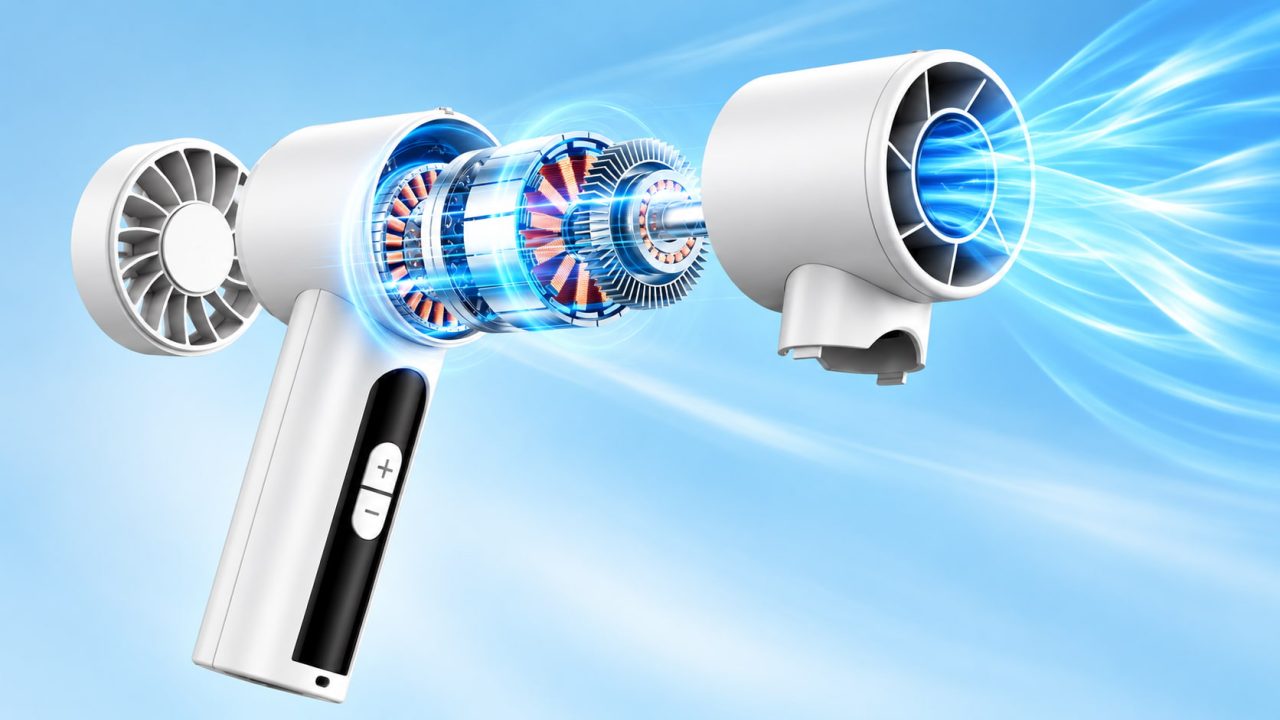
The airflow reaching you depends on several parts of the fan working together, including the motor, impeller or blade design, air inlet, outlet shape, internal air path, and operating speed.
This is why actual fan performance is normally judged through measurable airflow rather than marketing terms.
For example, the Air Movement and Control Association’s fan testing standards focus on measurable aerodynamic performance such as airflow rate.
Portable fans may instead publish air velocity in m/s. That number can be useful too, but only when you understand the testing conditions.
WindBillion’s Portable Fan Wind Speed guide explains why measurement distance and testing method matter when comparing fan speed.
Is a Turbo Fan Different From a High-Speed Mini Fan?
The two terms often describe similar products.
A turbo mini fan usually emphasizes strong airflow from a compact body. A high speed mini fan may be designed around the same goal without using the word Turbo.
From a buyer’s point of view, the distinction is not very important.
A product called Turbo is not automatically better than a high-speed fan with clearer specifications.
If one fan gives you useful information about airflow, speed levels, battery runtime, and weight while another only says “Turbo,” the first product is easier to evaluate.
The product name gets your attention. The specifications help you decide whether it is actually suitable.

When Is a Portable Turbo Fan Useful?
Higher-output portable fans are most useful when you sometimes need stronger airflow than a basic handheld fan can provide.
That may include:
- walking outdoors in warm weather;
- waiting in crowded or poorly ventilated places;
- moving between indoor and outdoor environments.
The important word is sometimes.
You may want maximum airflow outdoors but a much lower setting once you enter an office, café, train, or other indoor space.
That is why a good turbo handheld fan should not only have a strong top setting. It should also provide useful lower speeds.
Maximum power gives you more range. It should not be the only comfortable way to use the fan.

Does Stronger Airflow Always Mean Better Cooling?
Stronger airflow can feel more effective in hot conditions, but maximum output is not always the most comfortable setting.
At close range, a concentrated air stream may feel unnecessarily strong, especially with a compact high-speed fan.
The best setting depends on where you are, how close the fan is, and how much airflow you actually need.
This is another reason to look at the full speed range instead of judging a portable turbo fan only by its strongest mode.
What Should Real High-Speed Fan Specifications Show?
If a fan is marketed around Turbo or high-speed performance, look for specifications that help explain what that claim means.
Useful information can include:
- published air velocity or airflow;
- number of speed settings;
- battery capacity;
- stated runtime;
- product weight;
- dimensions;
- charging method.
For example, WindBillion’s Windmini Fan range includes the SD03 High-Speed Windmini Fan.
WindBillion describes the SD03 as a high-speed model rather than calling it a Turbo fan. Its published information includes five speed settings, a 2600mAh battery, a weight of about 135g, and up to 18 hours of runtime on low speed.
Those details are more useful than a Turbo label by itself because they show how the product balances airflow, portability, and battery use.
What Else Should You Compare Before Buying?
Turbo performance is only one part of the decision.
A fan may deliver very strong maximum airflow but still be less practical if it is too heavy, drains quickly at high output, or does not offer comfortable lower settings.
When comparing portable fans, look at:
- maximum airflow;
- usable speed range;
- battery runtime;
- weight and size;
- controls and display;
- charging method;
- intended use.
Battery information deserves particular attention.
Higher-output operation generally requires more power, so maximum-speed runtime can be much shorter than the longest advertised runtime measured at a lower setting.
That does not make the fan worse. It simply means you should compare runtime and performance together.
WindBillion’s Portable Fan Comparison shows how different models vary in airflow, battery capacity, speed settings, weight, and intended use.
A Turbo Label Should Be Backed by Real Performance
A portable turbo fan can be a useful choice when you want stronger airflow from a compact device, but the word Turbo should never be the only reason to buy one.
If a product uses the label but gives you little information about airflow, speed range, battery performance, or weight, the word itself tells you very little.
Look for specifications that explain what the fan can actually do.
A good turbo handheld fan should provide strong airflow when you need it, comfortable lower settings when you do not, and a practical balance between performance, battery life, and portability.