
A humidifier can add moisture to dry indoor air, but where you place it can affect how that moisture spreads through the room.
A unit positioned too close to a wall, bed, or other surface may leave moisture concentrated in one area. A crowded corner can also limit the open space available for mist to disperse.
If you are deciding where to place a humidifier, look for a stable surface, enough open space around the unit, and a position where nearby materials remain dry during normal use.
Where to Place a Humidifier in a Bedroom?
When deciding where to put a humidifier in a bedroom, start with the areas where you spend the most time, but do not assume that the closest possible position is automatically the best one.
A nightstand, dresser, or cabinet can all work for a compact humidifier. The right choice depends on clearance, mist direction, the type of surface, and what sits nearby.
How Far From the Bed Is Too Close?
Place a humidifier on a stable, open surface with enough clearance from your bed, walls, and moisture-sensitive items. There is no single distance that works for every room, so the surrounding surfaces are a better guide than one fixed measurement.
Mist output, furniture layout, airflow, and the direction of the mist all affect where moisture travels. If your bedding, headboard, nightstand, or nearby wall becomes damp, the humidifier may be too close or the mist output may be too high for that position.
The U.S. Environmental Protection Agency recommends that areas around humidifiers should not become damp or wet. If condensation appears on windows, walls, or other surfaces, the EPA advises reducing humidifier output or changing its position.
Read the EPA’s guidance on using and caring for home humidifiers.
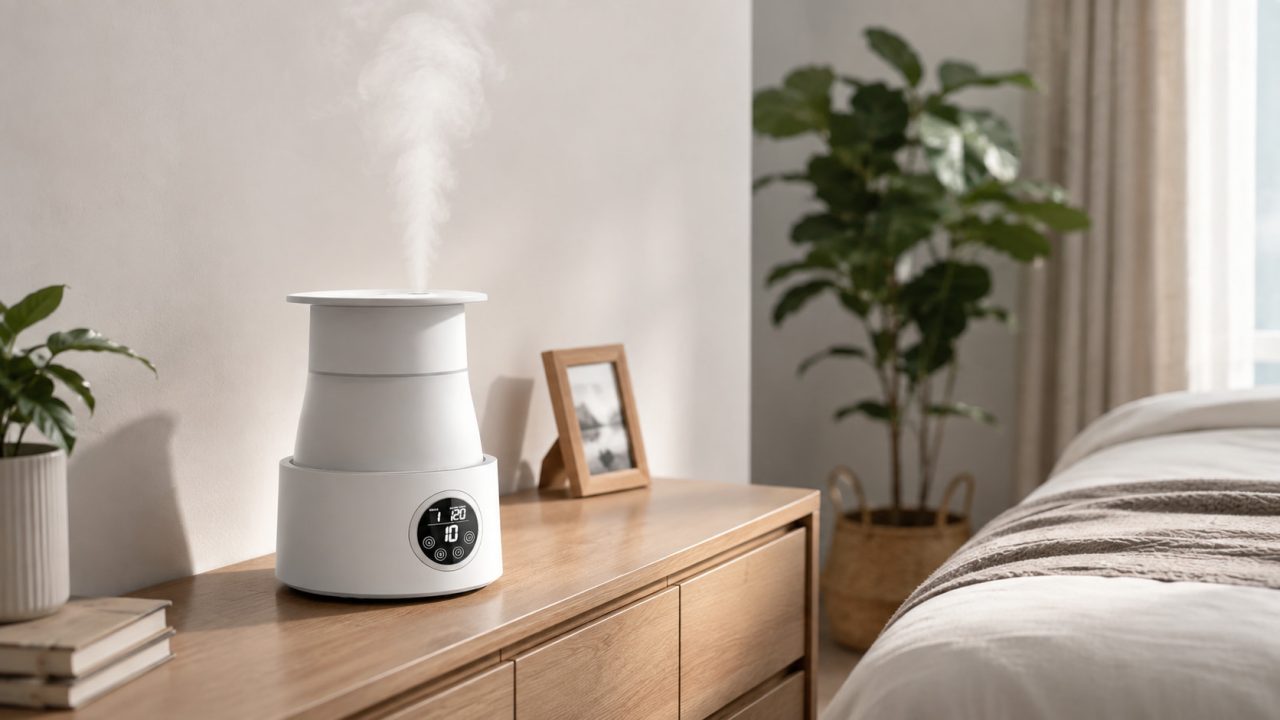
Choose a Stable, Open Surface
A nightstand, dresser, or cabinet can be a practical starting point when the surface is level and stable.
Avoid squeezing the humidifier between lamps, books, curtains, or decorative objects. Even if the unit technically fits, crowded surroundings can give mist less open space to disperse.
Height alone does not determine whether a position is good. A slightly lower but open surface may work better than a crowded shelf placed higher in the room.
Check Bedding, Walls, and Nearby Furniture
After the humidifier has been running for a while, inspect the immediate area.
Visible moisture on sheets, walls, furniture, or the surface beneath the unit is a sign that the current combination of position and mist output may need adjustment.
The goal is to add moisture to the surrounding air without continuously wetting one small area.
Places That Commonly Cause Moisture Problems
Some locations create a greater chance of moisture collecting where you do not want it.
Rather than following a rigid list of distances, look at what surrounds the humidifier and whether those materials can tolerate repeated exposure to visible mist.
Directly Against Walls or Under Shelves
Avoid pushing the unit tightly against a wall or placing it directly underneath shelving.
Mist needs room to move away from the outlet. If a wall or shelf is immediately in its path, moisture may repeatedly settle on that surface.
Near Electronics and Documents
In bedrooms and offices, keep visible mist from repeatedly reaching computers, monitors, power strips, books, and important papers.
The issue is not simply that electronics are present in the same room. It is whether moisture is being directed toward them or collecting nearby.
Next to Windows or Moisture-Sensitive Surfaces
Windows can provide a useful warning sign. Repeated condensation on nearby glass may indicate that too much moisture is accumulating in that area.
Delicate wood furniture, upholstered surfaces, curtains, and other moisture-sensitive materials also deserve extra clearance.
The EPA recommends keeping indoor relative humidity at no more than 50% when using a humidifier and reducing humidification if condensation or dampness develops.
Humidifier Placement in a Home Office
A home office has different practical concerns from a bedroom because the workspace usually contains more electronics, cables, paperwork, and charging equipment.
Good humidifier placement in an office should balance open airflow with convenience. The unit should be easy to use without sending visible mist across the equipment you work with every day.
Give the Mist an Open Path
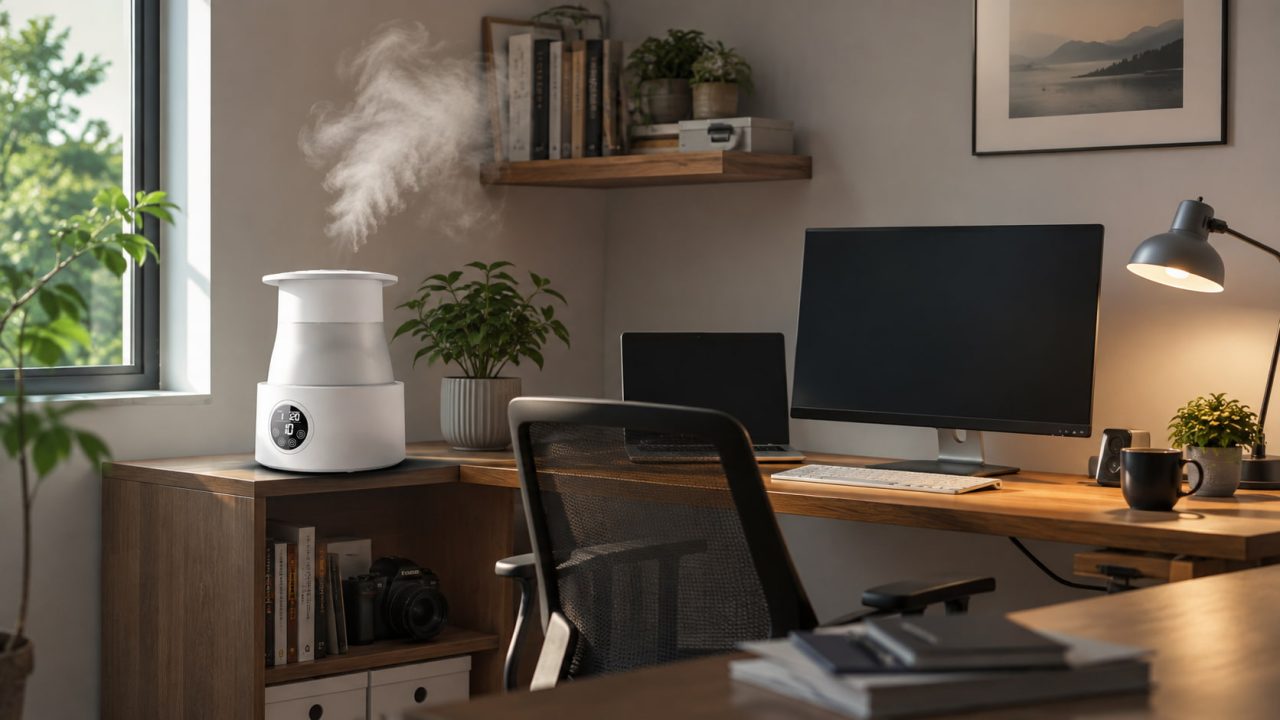
A clear section of a desk, side table, or cabinet can work well.
If the mist direction can be adjusted, aim it toward open room air rather than directly across a laptop, keyboard, monitor, printer, or stack of papers.
Avoid hiding the humidifier behind a monitor or pushing it into a tightly packed corner simply to save desk space.
Keep Refilling and Controls Easy to Reach
Placement should also make everyday use practical.
A location may look tidy but become inconvenient if you have to reach behind equipment every time you refill the tank or change a setting.
Choose a position that is stable, accessible, and unlikely to be knocked over during normal work.
Signs Your Humidifier Needs a Better Position
Poor placement often leaves visible clues before it becomes a larger moisture problem.
Instead of assuming the humidifier itself is malfunctioning, first look at how moisture is behaving around the unit.
Nearby Surfaces Stay Damp
Water droplets around the humidifier, damp curtains, wet furniture, or repeated condensation on a nearby window suggest that moisture is becoming concentrated in one area.
A small change in position or mist level may be enough to correct it.
Mist Falls Directly on Nearby Objects
Visible mist should have room to disperse into the surrounding air.
If most of it appears to be landing directly on bedding, walls, documents, or electronics, changing the direction or position of the humidifier is more useful than simply leaving it in the same spot.
Does Room Size Change the Best Position?
Room size can influence how moisture spreads, although it is not the only factor.
In a small bedroom, walls, furniture, and bedding are closer together, so mist may reach nearby surfaces more quickly. Open clearance around the humidifier becomes especially important.
A larger office provides more room, but placing the unit deep in a blocked corner can still restrict how freely the mist disperses.
When deciding where to place a humidifier in a larger or smaller room, you do not necessarily need to choose the exact center. A practical open position near the area you use most often can work well as long as nearby surfaces remain dry.
Using the WindBillion H50 in a Bedroom or Office
The WindBillion H50 Large Capacity Humidifier is designed for indoor spaces including bedrooms, offices, and study rooms.
Its compact body measures approximately 9 × 9 × 10.8 inches, allowing it to fit on surfaces such as desks, nightstands, and cabinets. Placement can then be adjusted according to the room and the objects around it.
H50 Placement in a Bedroom
A nightstand or cabinet can work when there is enough clearance from bedding, walls, curtains, and other nearby surfaces.
After the H50 has been running, check whether moisture is collecting around the unit. Its touch controls allow mist levels and available modes to be adjusted if less output is needed for that position.
H50 Placement in an Office
On a desk or cabinet, position the H50 so visible mist has an open path rather than travelling directly toward electronics or documents.
Keep the controls and tank accessible as well, so normal refilling and adjustments do not require moving other equipment each time.
Find a Position That Works With Your Room
There is no single answer to where to place a humidifier that works for every room, because layout, mist output, furniture, and airflow can all affect the best position.
Start with a stable surface and give the unit enough open space for mist to disperse. In a bedroom, pay particular attention to bedding, walls, and windows. In an office, consider electronics, documents, and how easily you can reach the humidifier.
Then watch how the room responds during use. If nearby surfaces remain dry and moisture is not concentrating in one small area, the humidifier is likely in a more suitable position.