
The best answer to where to put a fan in a tent is not simply “near your feet” or “next to the door.” The fan should move air through the space where you actually sleep.
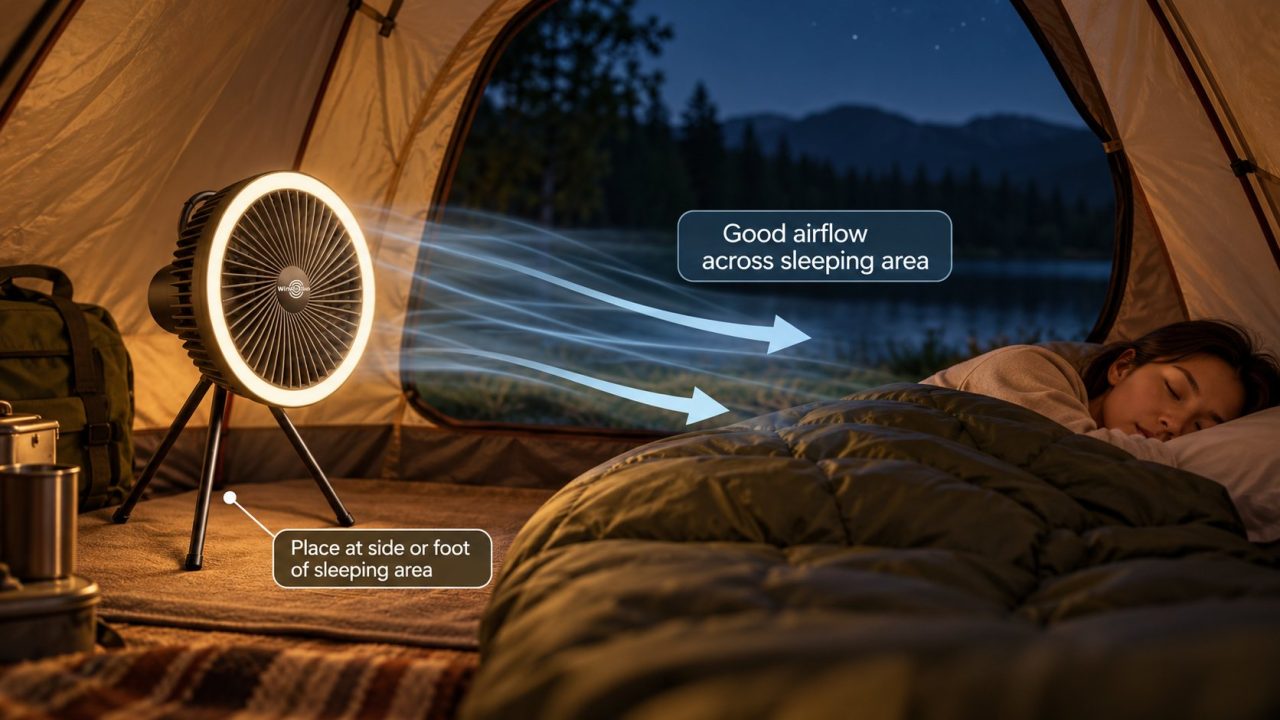
For many tents, the foot or side of a sleeping bag is a useful place to start. Then check the door, mesh panels, and vents. If the breeze hits a wall, disappears behind gear, or misses you when you lie down, change the position.
A good setup should move air across the occupied space. It should also keep the fan intake clear and avoid strong airflow directly at your face.
Build the Airflow Path Around Your Tent Layout
Before you place the fan, look at the tent layout. Check where you sleep and where air can enter or leave.
A floor fan such as the WindBillion H12 Camping Fan can sit near the resting area. However, do not place it in an empty corner just because the space is available.
If the Tent Has One Main Opening
A small tent may rely on one door or one large mesh section for most of its airflow. Do not choose the fan direction only by looking at that opening.
Lie down first. Check whether the breeze crosses your resting area before it reaches nearby fabric or leaves through the opening.
If the air exits through the door before it reaches you, turn the fan inward or at an angle. That gives the breeze more time to move across the occupied space.
Also check for smaller vents. A roof vent or mesh panel can affect the airflow path even when the tent has one main entrance.
If the Tent Has Openings on More Than One Side
Multiple openings give you more options.
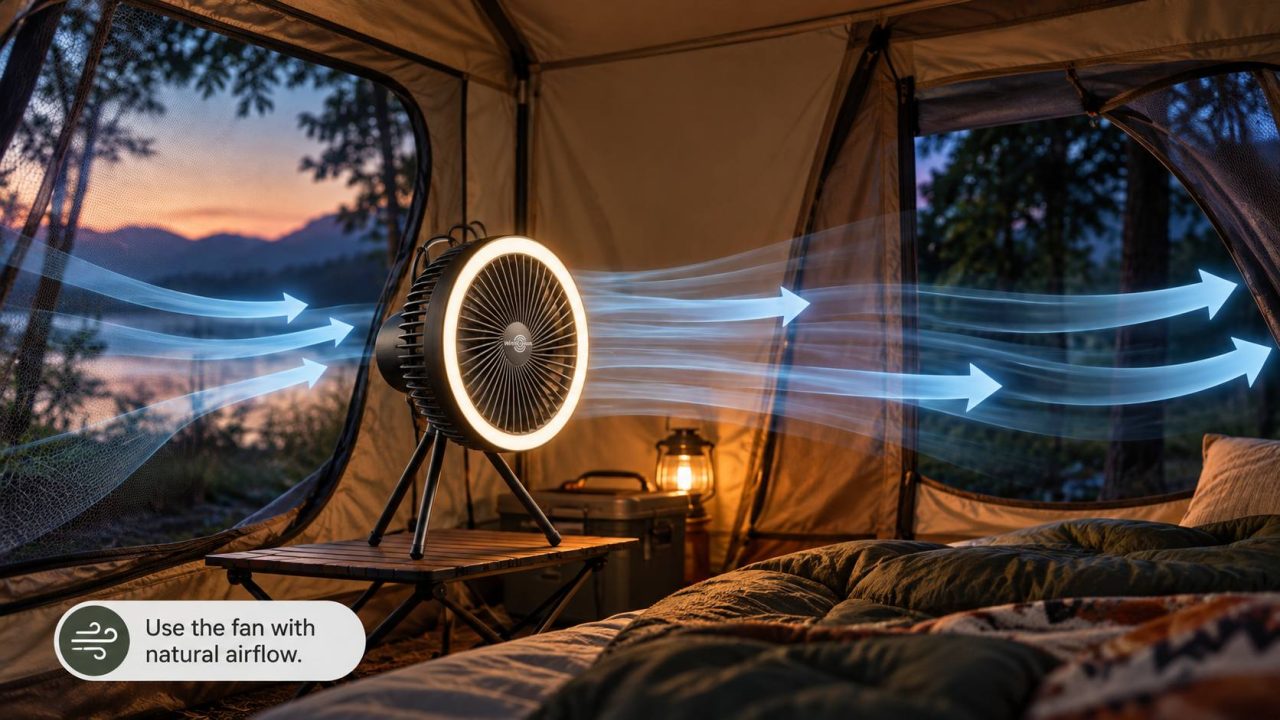
REI’s guide on preventing condensation in a tent recommends using available vents and inner tent windows to improve ventilation. When air can move from one side of the tent to another, the fan can support that path.
Try to point the fan in roughly the same direction as the natural airflow. Avoid sending most of the breeze into a closed wall.
The goal is simple: let the air pass through the place where you sleep before it leaves or loses momentum.
Adjust the Position Around the Space You Actually Have
Camping gear can change a good fan position very quickly.
Sleeping bags, backpacks, loose clothing, and tent fabric may sit close to the fan. In a small tent, even a minor obstruction can change how much airflow reaches you.
In a Small Tent, Change the Angle Before Adding More Speed
A nearby fan can feel too strong even at a moderate setting.
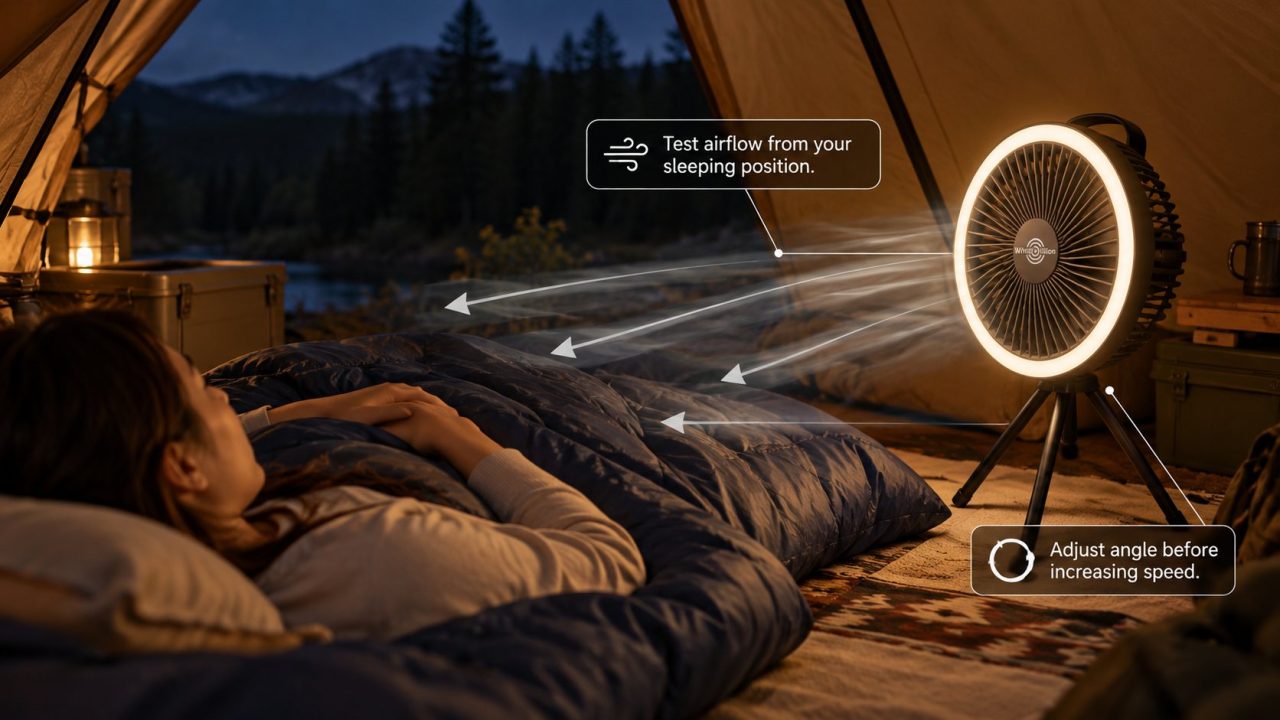
If the breeze hits only your face or feet, move the fan slightly to one side. Then aim the airflow across your body instead of directly at it.
This change can spread the breeze over a larger area. You may not need more fan speed.
If the airflow still feels too concentrated, move the fan closer to the foot end. You can also increase the sideways angle.
When the Tent Is Crowded With Gear
A backpack or sleeping bag can make a good fan feel weak.
Check the intake first. Make sure tent fabric, clothing, or luggage does not sit too close to it. Then check the outlet. Do not point the fan straight into a backpack, wall, or pile of bedding.
Clear those obstacles before you decide the fan lacks power.
A clip-on tent fan can help when floor space is tight. Still, height alone does not improve airflow. Make sure the breeze reaches the place where you sleep.
Diagnose the Problem From Your Sleeping Position
The easiest way to decide where to put a fan in a tent is to test it after you finish setting up camp.
Lay out your sleeping bag, pad, or cot. Put your normal gear in place. Then lie down and run the fan at the speed you expect to use at night.
What you feel tells you what to change.
If you feel air only around your feet, tilt the fan so the breeze travels farther along your body.
If you barely feel any airflow, check the intake and outlet for obstacles before you raise the speed.
If the breeze feels strong but uncomfortable, move the fan to the side. Aim it across your body rather than straight at you.
If the fan feels strong up close but weak from your sleeping position, look for a poor angle or an object in the airflow path.
A fan also does not replace tent ventilation. Closed doors, mesh panels, and vents limit air exchange with the outdoors. The fan can still circulate indoor air, but it cannot create the same outside airflow.
The Best Fan Position Creates a Clear Path Across Where You Sleep
For many camping setups, the foot or side of the sleeping area is a useful starting point. The final position should depend on what the airflow does after you turn the fan on.
The breeze should reach you without hitting gear, tent fabric, or a nearby wall first. The intake should stay clear. The fan should also remain stable while you move inside the tent.
That is the practical way to decide where to put a fan in a tent. Follow the airflow and find where it stops or misses you. Then adjust the angle or position until the breeze reaches your sleeping space.