
A misting fan can feel cooler than a regular fan, but mist is not automatically the better choice in every environment.
A regular fan mainly moves existing air around the body. A misting fan adds fine water droplets to that airflow, giving evaporation an opportunity to provide additional cooling when the surrounding conditions support it.
So the question “does a misting fan cool better?” cannot be answered by the mist function alone. Humidity, ventilation, location, and whether added moisture is actually useful all affect which type of fan makes more sense.
How a Misting Fan and Regular Fan Cool Differently
Both types of fans move air, but they do not create comfort in exactly the same way.
The important difference is what happens after water is added. A regular fan relies mainly on airflow, while a misting fan gives water droplets an opportunity to evaporate alongside that airflow.
A Regular Fan Mainly Moves Existing Air
A regular fan circulates the air that is already around you.
It can improve comfort by increasing airflow across the body, but it does not work like an air conditioner that actively removes heat from indoor air.
That distinction matters when deciding what you actually need.
If your goal is a steady breeze at a desk, beside a bed, or while sitting outdoors, normal airflow may already solve the problem. A regular fan also avoids introducing additional water around electronics, documents, furniture, or clothing.
If airflow is your main priority but you are still comparing different portable fan formats, WindBillion’s portable fan buying guide explains how location, portability, runtime, and hands-free use can affect the choice.
A Misting Fan Adds Evaporative Cooling
A misting fan releases fine water droplets into the moving air.
When those droplets evaporate, heat is absorbed during the evaporation process. This gives mist the potential to provide additional cooling alongside the airflow.
The important part is evaporation, not simply spraying more water.
If visible droplets repeatedly remain on your skin, clothing, or nearby surfaces, at least some of the water is not evaporating quickly. More mist therefore does not automatically mean more effective cooling.
That is why a misting fan vs regular fan comparison should focus on the conditions where the fan will actually operate, not simply on which model has more functions.

When Does Mist Actually Add More Cooling?
Humidity and location are the two conditions most likely to change the result.
Dry air gives water more opportunity to evaporate. Higher humidity reduces that opportunity because the air already contains more water vapor. Location matters because added moisture may be welcome on a hot patio but inconvenient beside a laptop or paperwork.
For anyone asking “does a misting fan cool better in humid weather?”, humidity is therefore one of the first things to consider.
Humidity Changes How Well Mist Can Evaporate
The National Weather Service explains that evaporation becomes less effective as the amount of water vapor in the air increases. As air approaches saturation, the potential for evaporative cooling also decreases. Its guidance on wet-bulb temperature and evaporation explains this relationship.
In hot, relatively dry conditions, fine mist has more opportunity to evaporate.
Very humid air creates a different situation. Mist may still feel refreshing, but additional droplets can evaporate more slowly and are more likely to remain on skin or nearby objects.
A simple observation can help. When mist disperses quickly and surrounding surfaces remain mostly dry, conditions are more favorable for evaporation. If clothing, tables, or furniture repeatedly become visibly wet, more of the water is remaining as liquid.
This is a practical observation, not a laboratory test, and it cannot tell you exactly how much cooling the mist provides.
It can, however, help you judge whether the environment is favorable for evaporative cooling rather than assuming mist must always feel cooler.
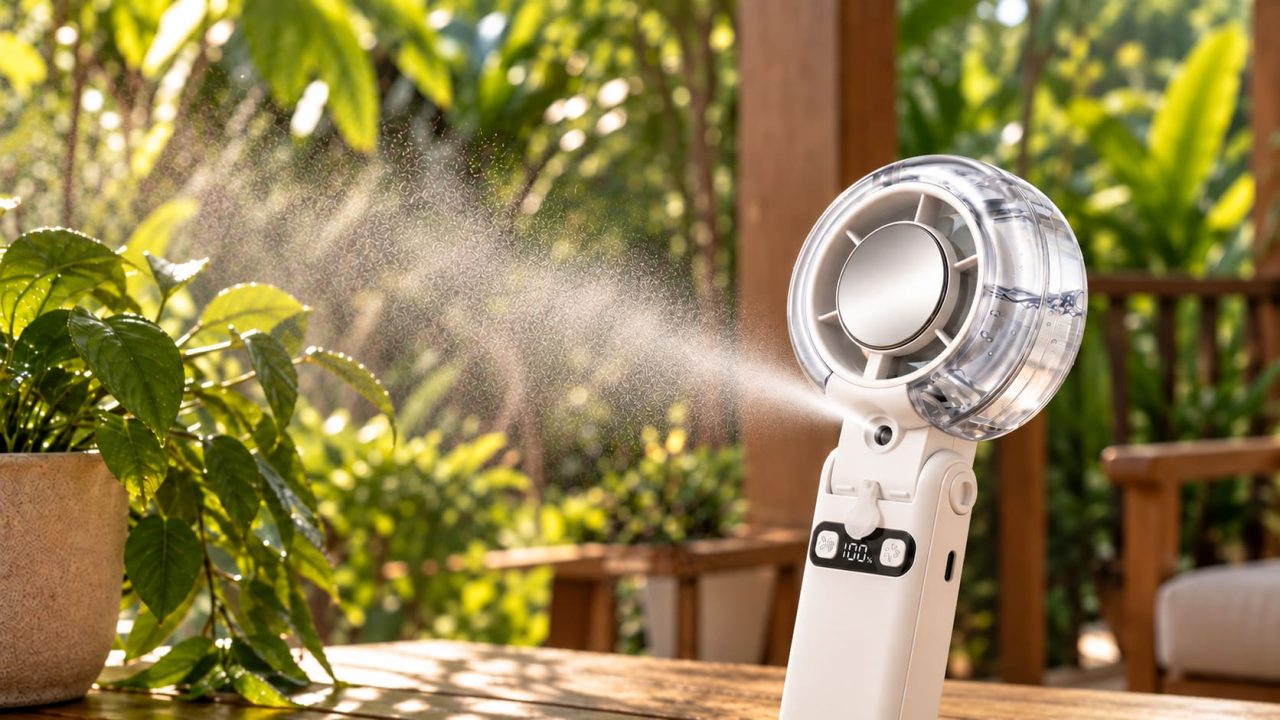
Location Changes Whether Added Moisture Is Useful
Outdoor use alone does not automatically make a misting fan the better choice.
A hot, relatively dry, well-ventilated patio or campsite gives fine droplets more opportunity to disperse and evaporate. A hot but humid outdoor environment can behave differently.
Indoors, another question becomes important: where will the water go?
An office desk may contain a laptop, monitor, books, paperwork, or wood furniture. If visible droplets can reach those items, a regular fan may be the more practical option.
Indoor humidity also matters. Adding mist to an already humid room may provide little additional benefit.
This is why “does a misting fan cool better?” has a different answer at a dry campsite than it may have at a humid indoor desk. Location and humidity need to be considered together.
How Should You Choose Between Them?
The better choice depends on the environment and the cooling job you actually need the fan to perform.
Instead of asking which type is universally better, use the conditions where the fan will operate to narrow the decision.
| Your Situation | More Likely to Make Sense | Why |
|---|---|---|
| Hot, relatively dry outdoor conditions | Misting fan | Mist has more opportunity to evaporate |
| Hot and very humid conditions | Depends | Additional water may evaporate more slowly |
| Desk with electronics or paperwork nearby | Regular fan | Avoids unnecessary moisture around sensitive items |
| Hot, dry, well-ventilated patio or campsite | Misting fan | Conditions are more favorable for evaporation |
| You mainly need steady airflow | Regular fan | Mist may not solve an additional cooling problem |
| You want both airflow and optional mist | Misting fan with separate controls | You can adapt as conditions change |
Choose a Regular Fan When Airflow Is Enough
A regular fan is more likely to make sense when your main requirement is continuous airflow and added moisture does not solve an important problem.
That may include office use, moisture-sensitive indoor spaces, or humid weather where evaporation is less favorable.
Choosing a regular fan in these situations does not mean choosing an inferior cooling method. It means airflow already matches the job you need the fan to do.

Choose a Misting Fan When the Conditions Support Evaporation
A misting fan becomes more useful when the weather is hot and relatively dry, and the location allows droplets to evaporate and disperse without creating moisture problems.
If mist suits your environment, separate fan and mist controls can be useful because they allow you to return to normal airflow when mist is unnecessary. Tank capacity should also be considered together with published mist duration, since a larger tank alone does not prove how long the mist will last.
You can then compare WindBillion’s FS36 and FB23 misting fans to see how their mist, battery, tank capacity, and usage modes differ.
So, does a misting fan cool better? It can when the air is hot, relatively dry, and well ventilated because those conditions give water more opportunity to evaporate.
In very humid conditions, around moisture-sensitive equipment, or when steady airflow already provides the comfort you need, a regular fan may be the more practical choice.
The better option is not simply the fan with more functions. It is the one whose cooling method fits the humidity, location, and way you actually plan to use it.