
The right collapsible fan for an RV comes down to four things: enough battery to last the night without shore power, noise low enough for a quiet campsite, a fold-flat body that survives the drive without eating storage space, and a height that adjusts to however your interior is set up. Most portable fans check one or two of those boxes. Few check all four. Here’s how to find one that does.
Why RV Cooling Calls for a Different Kind of Collapsible Fan
A fan that works perfectly in a home bedroom can fail quickly inside an RV. The conditions are different, and the gaps show up fast — usually on the first warm night without hookups.
Shore Power Isn’t Always There
Dispersed camping, overflow lots, and remote scenic stops all share one thing: no electrical connection. A foldable fan that only runs when plugged into a wall outlet becomes useless the moment you leave a full-hookup site. You need a cordless fan with its own battery — and that battery needs to be large enough to cover a full night of sleep, not just a few hours before the indicator light starts blinking.
This is where most budget portable fans fall short. A 4000mAh battery might last four or five hours on low. That’s fine for an afternoon on a patio. It’s not enough for an 8-hour night when temperatures don’t drop until well past midnight.
Quiet Matters More Than You Expect
An RV at a quiet campsite is genuinely silent at night. There’s no city hum, no building ventilation, no ambient noise to mask a rattling motor. In that stillness, even a small vibration from a cheap fan motor becomes the thing you lie awake noticing. A compact travel fan that runs consistently without humming, clicking, or changing tone as it warms up is not a luxury for RV use. It’s a baseline requirement.
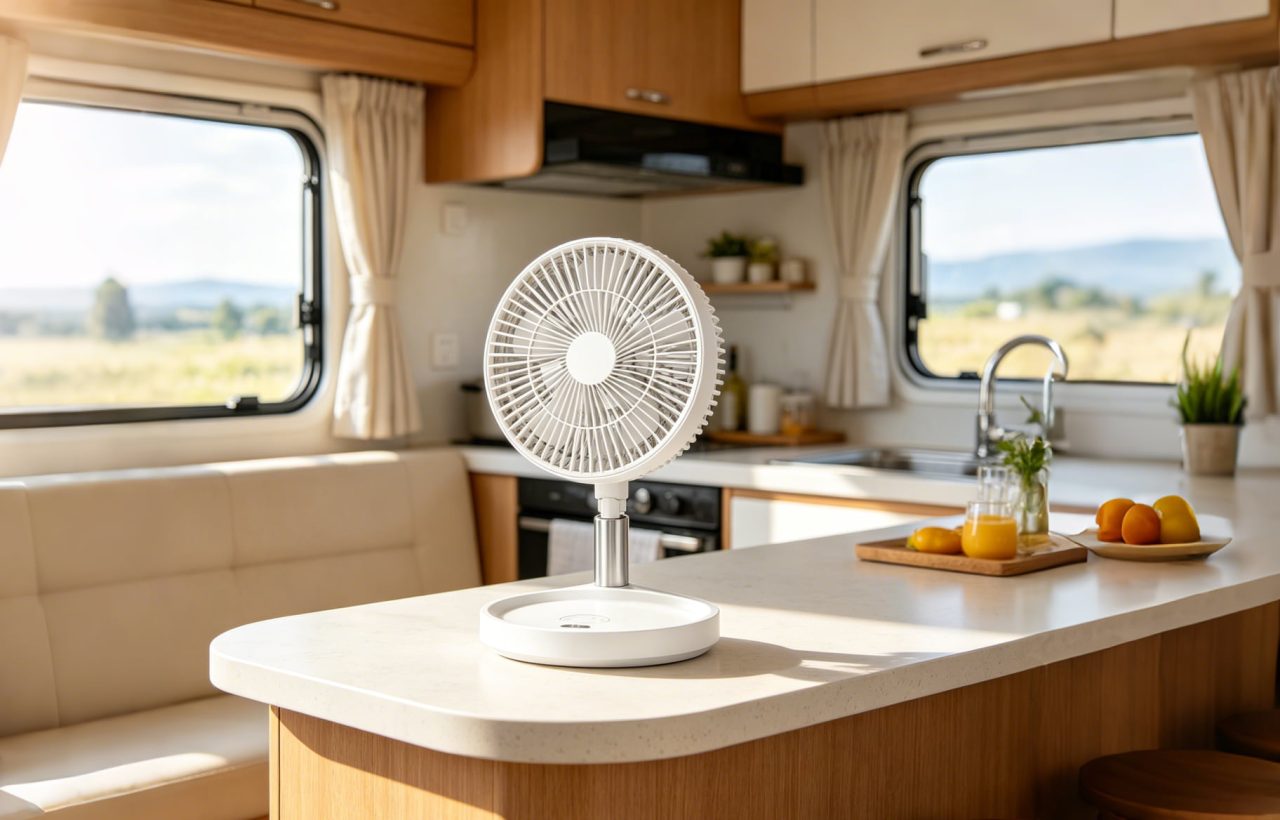
What to Look for in an Adjustable Folding Fan for RV Use
Once you understand why standard fans fall short, the selection criteria become specific. Check these four things before buying any portable foldable fan for RV or van life use.
Battery Capacity and Real-World Runtime
Headline runtime figures on fan packaging assume the lowest speed setting. A collapsible fan rated for 10 to 37 hours gives you a useful range: the lower end represents high-speed use on a hot afternoon, the upper end covers quiet overnight cooling at low speed. For a single night of sleep, you need a fan that can sustain at least 8 continuous hours at a mid-range setting — which in practice requires at least 10000mAh of battery capacity, and ideally more.
A 16000mAh battery running between 10 and 37 hours is the kind of spec that actually covers RV travel across different conditions, not just the best-case scenario printed on the box.
Noise Level at the Speeds You Actually Use
High speed is rarely what you run at 11 p.m. The relevant question is how the fan sounds at low and mid settings — the two speeds that get used most during sleep and relaxed evening hours. A brushless DC motor at 1.2W is fundamentally quieter and smoother than a brushed motor at the same output. Look for that distinction in the spec sheet, not just a vague “quiet operation” claim.
Fold Dimensions and Weight
For an RV, the folded size matters as much as the operating size. A rechargeable fan for camping that folds down to roughly 11 × 10 × 3 inches fits into a standard overhead compartment or cabinet shelf without requiring a dedicated slot. Weight under 3.5 pounds keeps daily moves between setups easy — carrying it from the sleeping area to the dinette and back shouldn’t feel like a task.
Charging Compatibility Off-Grid
Type-C charging that works with power banks, solar panels, and 12V USB adapters gives you flexibility when you’re away from shore power for days at a time. Proprietary charging ports that require a specific wall adapter turn recharging into a logistical problem the moment that one adapter gets left behind or stops working mid-trip.
A Collapsible Fan Designed Around Real RV Conditions
The WindBillion Collapsible Fan H6 is a collapsible fan built around the specific demands of multi-scene use — home, office, and outdoor cooling, including RV and camping applications. Its specs address each of the criteria above without compromise.
Battery and Power Output
The H6 carries a 16000mAh lithium battery with a working output range of 1.2 to 5W across speed settings, delivering 10 to 37 hours of continuous runtime on a full charge. At low speed, a single charge covers four or five consecutive nights before you need to top it up — meaning one session at a powered campsite carries you through a full week of off-grid travel. At higher speeds for quick afternoon relief after a long, hot drive, it handles a full day in one charge without issue.
Charging runs via Type-C at 12V/1.5A, compatible with most power banks, laptop USB-C ports, solar charging panels, and standard vehicle USB adapters. No proprietary charger to carry. No compatibility gap to work around.
Build Quality and Folded Size
The H6 body is ABS aluminium — 3.1 pounds total, which is light enough to move between setups without thinking about it. Folded dimensions are 11.8 × 10.2 × 3 × 4.6 inches, which fit cleanly into an RV overhead compartment, a cabinet shelf, or the narrow space beside a passenger seat without wedging or forcing. Thaluminiumum components handle the temperature swings of RV travel better than all-plastic bodies, which can warp or loosen at hinge points over a season of use. Available in six colours — Obsidian Black, Ivory White, Mint Green, Turquoise Blue, Barbie Pink, and Windsor Tan — so it fits the interior you have, rather than defaulting to basic black.
Desktop and Floor Mode for Any RV Layout
The H6 switches between desktop and floor-standing mode without tools or extra parts. On a fold-out dinette table, desktop mode keeps it compact and at working height without blocking sightlines across the table. Extended to floor mode, it stands and circulates air across the sleeping area or main living space at the height where you actually feel it. That two-mode flexibility covers the main configurations travellers use most, without needing separate fans for separate situations.
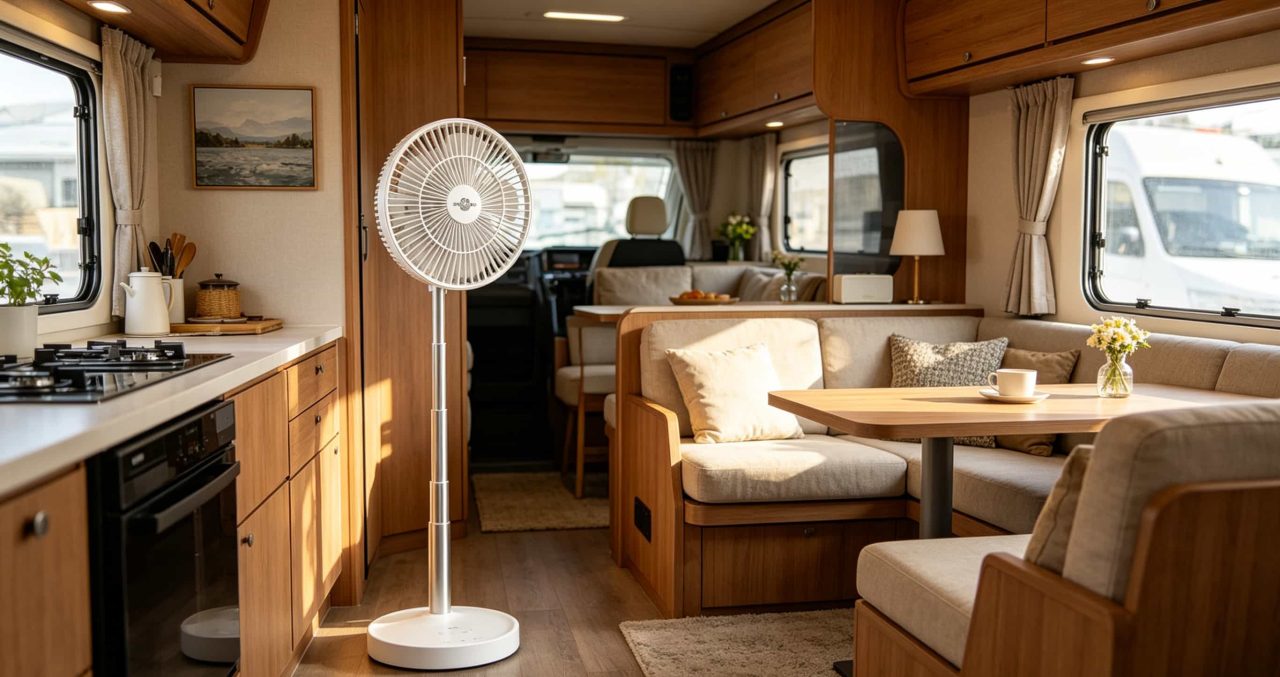
How a Collapsible Fan Fits Every Part of an RV Trip
The way a foldable fan actually gets used across a full RV trip varies more than most buyers anticipate. It’s not just a bedside appliance.
On the Drive
While the vehicle is moving, the H6 sits folded in a storage compartment — no loose parts, no rattling in transit, no need to wedge it between cushions to keep it still. Pull into a campsite after a long afternoon on the road, and it unfolds and runs in under ten seconds. That speed matters when the interior has been baking in the sun for hours,s and you want airflow immediately, not after fiddling with setup.
At Camp — With or Without Hookups
At a powered site, the H6 runs entirely on its own battery, leaving your shore power outlets free for charging devices, running a coffee maker, or anything else that actually needs the outlet. When camping at a dry campsite with no power supply, it runs entirely on battery power all night long—no generator noise, no fuel costs, and no compromise on sleep quality.
When the trip ends, it folds flat and disappears into storage until the next outing. No dedicated parking spot in the RV is required. No annual reassembly ritual before the first warm trip of the season.
The Collapsible Fan That Earns Its Place in the Vehicle Every Trip
Choosing a collapsible fan for RV use isn’t complicated once you know what to actually check. A battery that covers real overnight use without shore power. A motor quiet enough for campsite silence. Dimensions that fold into standard RV storage. Charging that works from what’s already in the vehicle.
The WindBillion Foldable Fan H6 hits all four. At 3.1 pounds, 16000mAh, 10 to 37 hours of runtime, Type-C compatibility, and a fold-flat body that switches between desktop and floor mode in seconds, it’s the kind of portable fan that earns its place in the RV on every trip — warm weather or otherwise.